Sunday, December 11, 2011

Reflections on Reason and Faith: Part I

 A long time ago, possibly before I turned 10, maybe after, I made up my mind to never, ever, consciously, concurrently hold beliefs that either contradict one another, or that have simply been proved false. From creationism to nearly all strains of Dharmic religion, to objective morality in an atheistic construct of the universe, I've critically examined and dismissed so many creeds (Mormonism, anyone?), philosophical propositions and other, half-baked, no-brained postulates that I can't even remember half of them. I can say with a considerable degree of confidence that there was never much uncertainty in my conclusions, nor have I ever clung to any belief, religious or secular, after it had been conclusively shown to be false. People who have known me long enough can attest to my gradual shift from Biblical literalism, Creationism, Manicheanism and a whole horde of other idiotic "isms" to the glorious spiritual and intellectual harbor of Catholicism, in whose embrace faith and reason have struck the perfect balance of interdependence and autonomy. Since that time I have taken as my motto and philosophy the words of that luminous mind, Aquinas, who said over seven centuries ago that, "The truth of our faith becomes a matter of ridicule among the infidels if any Catholic, not gifted with the necessary scientific learning, presents as dogma what scientific scrutiny shows to be false."

    Indeed, no one who has faith in the God Who wrought existence from the void should ever fear the progress of science, for, as the Fathers unanimously attest, science and revelation can never truly contradict; on the contrary, they can only serve to clarify one another, and, in the process, allow the light of truth to shine forth with ever-increasing radiance. Any such fear of science, then, betrays both a lack of faith in revelation and a stubborn resistance to the irresistable force of Truth as unveiled by our God-given faculties of reason and critical-thinking. Indeed, if one were to trace this fear to its root causes, the sentiments that give rise to it might be deemed heretical. Despite all this inherent sense, I don't want to give the impression that Catholicism has always, even on an official, magisteral level, lived up to its own standards. Nobody needs to be reminded of Galileo (whose condemnation and subsequent incarceration, ironically, had almost nothing to do with the doctrinal implications of his astronomical theories) or Copernicus (same story), however, people should know, for example, about the initial hostility to Darwin's theories on the part of the German episcopate, apathy on the part of the Vatican, and seemingly willful non-engagement or tacit condemnation by all pontiffs until Pius XII. Even today, critical literary and archeological concerns which have been raised concerning the pre-Davidic Patriarchs such as Noah and Moses, figures essential not only to Catholics, but to all claiming spiritual descent from Abraham (who himself has evidently fallen under the blade of historical-critical exegesis), have gone unaddressed by Church authorities. Their hesitancy is, at best, understandable. The policy espoused by Aquinas would require Mother Church to shed, almost certainly with great difficulty, certain propositions which, despite having attained practical dogmatic status, have failed to withstand the modern advances of biology, geology and literary criticism. Even more difficult is the matter of reconciling the truly fundamental doctrine of Original Sin with what we now know about the true origins of humanity, an issue so tense and volatile that even the indefatigable Pius XII himself ducked it, effectively foisting responsibility for this particular reconciliation of faith and reason onto future generations. However, despite the self-imposed difficulties the Church in grappling with these issues, She has not only the equipment to do so, but an obligation to do so, as well. To continue as is without addressing these crucial concerns would be nothing less than a wholesale betrayal of Catholicism's own philosophical methodology as enunciated by Aquinas, Augustine and the other Latin Fathers. Which brings me back to my opening statements and the point of this essay.

    Despite being in the era of the Enlightenment, what some have somewhat preumptiously dubbed "the Age of Reason", some individuals and religions, unlike myself or my faith, have neither the tools nor the desire to reconcile faith and reason. This is tolerable (not, I emphasize, good or desirable) when said religions have no global aspirations, open themselves to criticism, questioning and examination by those who disagree with their fundamental tenets. I'll openly name some; Mormonism, Rastafarianism, and Buddhism. Yeah, they're bullshit, alright; but, and this is crucial, Rastafarians won't decapitate you if you say it. I've sat down and talked with Mormons and Buddhists and we've actually made headway, albeit in Catholicism's favor, but, still. They were willing to sit down and talk, as are 99% of their co-religionists. And, all of us are, really. We pick, we nag, we ridicule one another, but, that's pretty much the extent of it. Bill Donahue ends up frothing on Fox News, Richard Dawkins will sneer condescendingly about the evils of religion, the Dalai Lama will laugh like your mentally-unstable Asian great-uncle and the world keeps on spinning. Nobody gets hurt. One religion, however, is not playing nice. Not only is it refusing to submit itself to critical evaluation, or let others do so, for that matter, but, on top of all that, it will not shut up and leave the rest of the world alone. Its not small, either. At 1.57 billion adherents, its the world's second largest and fastest growing religion, claiming over 1 fifth of humanity. And it speaks Arabic.

Know thy Enemy: Understanding Atheism and the War on Faith


"But those mine enemies, which would not that I should reign over them, bring hither, and slay them before me."
- Luke 19:27

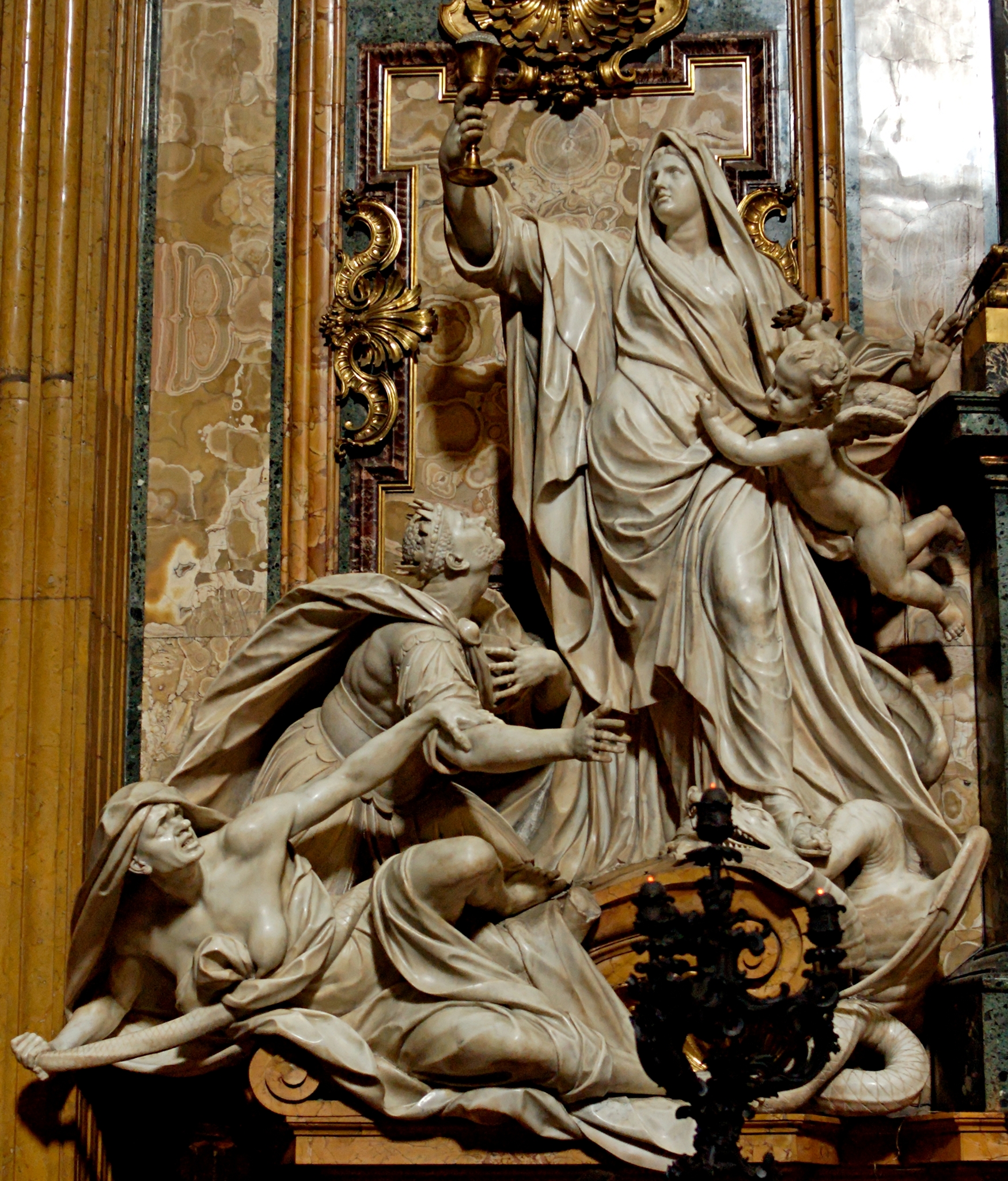
Triumph of Faith over Idolatry. Jean-Baptist Theoden. Chiesa del Gesu, Rome.

In case you've been living under a rock for the past 10 years, there's been something of war on religion in the public square. The chief assailants are atheist intellectuals, the most prominent among them being the aptly-named, "Four Horsemen"; Hitchens, Harris, Dawkins and Dennett, and a whole host of knuckle-dragging secularists who can't tell the difference between Kierkegaardian existentialism and Nietzscheism. As Catholics, its incumbent upon us to stand up and defend the role of religion in society. And, in a world where knowledge is power, the first step in this defense is understanding the intellectual divide between believers and atheists. Here are some tips in that regard.

1. Familiarize yourself with atheist thought (and its flaws): Nothing is more agonizing than watching an ignorant, albeit well-meaning, Christian debate an atheist. Unfortunately, the average atheist is better versed in the art of debate and philosophy than the average Christian. In a particularly cringe-inducing example, I recall a debate broadcast on British television wherein an African Archbishop, someone whom you'd hope would know how to handle himself intellectually, was being verbally pummeled by atheists extraordinaire Christopher Hitchens and Stephen Fry. With copious amounts of platitude and logical fallacies, the good Archbishop somehow managed to convince an initially ambivalent audience that Christianity was not a force for good. FYI, these things are not good for Christianity.

Not for the faint of heart.

A good way avoid looking like an idiot in similar situations is to read up on atheist literature. From Hitchens to Russell, familiarizing yourself with the Apostles of Godlessness, and the flaws of their arguments, can do enormous good when trying to establish intellectual credibility. If you know their sages better than they do, you're already a step ahead in the game. If you've never heard of "the problem of evil" or the "omnipotence paradox", you're really not doing Christianity any favors.
2. Don't act like a jackass: I myself am prone to it; acting like a pompous idiot during a debate with an atheist, that is. Its very easy to fall into, really. So convinced are we of the truth of our faith, that we sometimes forget to consider the (improbable) possibility that we've got it all wrong. In doing so, we permit ourselves to turn our noses up at unbelievers, declaring them unworthy of taking seriously. This is toxic, brethren. Firstly, it makes us look like arrogant pricks who are themselves unworthy of taking seriously. Secondly, it can lead to intellectual laziness that allows the opposition to tear our own arguments apart. Either way, it isn't good.

3. Pick fights: After having equipped yourself with adequate knowledge, its time to go out and pick a fight with an atheist. Now, let me clarify. I'm not saying to go declare a crusade on the normally amiable, unbelieving co-worker in the cubicle next to yours, nor am I suggesting that you punch an atheist activist in the face whilst screaming "GOD WILLS IT" (as satisfying as that is in theory). What I'm saying is this. If you run into a person who states, "I'm not that religious" or "I don't believe in God", start a conversation.For example...

Ted: Man, Obama's really assaulting our religious liberty...
Bob: Eh. I don't believe in God, so...
Ted: You don't believe in God?
Bob: Nope.
Ted: Tell me, have you ever heard of Thomas Aquinas...?

Saturday, December 10, 2011

Oremus: Praying in the midst of Despair

"Ask, and it shall be given you; seek, and ye shall find; knock, and it shall be opened unto you:"
- Matthew 7:7

Christ in the Wilderness, Ivan Kramskoy, 1872

The painting pictured above happens to be my all-time-favorite of Jesus. People often make a big deal about how God became man, sharing our physicality in both its glorious and mundane aspects. However, no one seems to want to paint the mundane aspects. Except for this guy, that is. I mean, it figures. Leave it to a Russian to paint Jesus as one of us, really one of us. There's nothing glorious about Him here, no rays of majesty or ethereal light. Just a dude sitting on a rock. Bored. Slightly despondent, even. Substitute the robes with skinny jeans and he could be the spitting image of your jobless, pot-smoking cousin. And, yet, He's God Almighty, the Alpha and Omega, the Lord of Majesty and Master of the Day of Judgement. Creator of the Universe, Savior of the World. God! Sitting on a rock. Bored. Crazy, right? Damn near unbelievable, even. And yet, there it is. What does this have to do with prayer, you ask? I'll tell you.

As anyone who has ever prayed and felt nothing should be able to relate to this painting. Even Christ's physical position, sitting with head stooped and hands folded, eyes staring blankly forward whilst trying with ever-increasing futility to barge mentally into the divine presence, should ring a bell with any amateur mystic. And this painting, intentionally or not, tells us that, you know what? That's okay. Not every prayer, Christ's bags show us, will result in spiritual ecstasy. Perhaps not even most prayers. Perhaps not even any prayers. Even Jesus, GOD INCARNATE, had His spiritual dry spots. How do we mere mortals, then, deal with them?

1. Integrity: "He who loves me keeps my commandments" says Christ in the Gospels (cf?). 

Verbum Domini: Familiarity with the Scriptures

"Ignorance of the scriptures is ignorance of Christ."
- St. Jerome

Jerome being studious.

As with most things, the Doctor of the Church minced no words when telling others what he thought of scriptural ignorance. For Jerome, the guy who single-handedly re-translated the entire Bible from Hebrew and Greek into Latin without the internet, biblical literacy was kind of a big thing and it was incumbent upon all believers to familiarize themselves with the holy texts. Its common sense, when you think about it. For Christians, the Bible is an essential component of their knowledge about God. It contains all the confirmed teachings of Christ, the Apostles, Prophets, Sages and Kings. It records salvation history, and is bursting with poetry, myth and all sort of spiritually efficacious materials for the average Homo Sapien. How is it, then, that people, and Catholics in particular, have almost completely lost touch with the scriptures?


Well, that's a complicated question that we don't necessarily have time to delve into within the confines of this blog. What we do have time for, however, is solutions to this problem. 

1. Get a good Bible: Unfortunately, while most homes in America have a Bible, its usually some expired, unintelligible edition of the King James which sits on a shelf gathering dust. The Bible, unfortunately, is not an integral part of people's lives. A Christian's Bible should be ragged, worn down and dog-eared from merciless, daily use. Its pages should be stuffed with sacred family mementos, highlights and personal notes. It should also be understandable. For all its historical and aesthetic value, the King James version is not a scripture fit for men of the 21st century, unless these men happen to be fluent in 17th century English. Aside from that, its missing books. Every Christian should find a version of the Bible (Catholic, of course) that is both easy to understand and faithful to the original languages. 

2. Set aside time to read it: Its crucial that we make the Bible a normal part of our lives, and a crucial component of doing that is actively setting aside time every day to contemplate its message. Personally, I like to get up just before dawn and immediately start reading after my prayers. You'll find that your mind is more relaxed and that the quiet of the early morning is the perfect time for contemplation. It also helps to put everything in perspective. Make sure to supplement the particular verses your reading with musings on the same by Saints, popes and other Christians who have something informative to say about them. We're not Protestants. We don't read the scripture in a vacuum, as though we're the only ones we need to reference. We read scripture as a family. Just as you might ask a parent about something, so to we should unabashedly run to the Saints to inform us on one thing or another.

3. Let it influence you: Someone, though I can't remember who, once said that the Gospel is like a wild animal, and that if we simply let it lose it will conquer everything. I buy that. I think that if we take the Bible, properly interpreted of course, and simply let it be itself and actually have a say in our lives, the world would be a very different, and better, place. So, crack open that old King James on the shelf and start making notes. Its a start, anyway. Who knows? You might just light the world on fire.

Someone who took the Bible seriously.

Secularism: A Proposal

"The fool hath said in his heart, There is no God. They are corrupt, they have done abominable works, there is none that doeth good."
- Psalm 14:1

Vous avez le cervau d'un sandwich au fromage.

Tis' the season, O Christians, when the secularists come out of the wood-work and try to sabotage everyone's Christmas cheer (yes, Christmas. Have you ever seen a secularist go after a menorah? Thought not.) For some reason or another, and in direct contrast to all their squawking about liberty and free speech, they immediately start frothing at the mouth when confronted with that most heinous of secularism's violations; the public Nativity Scene. You would have thought we had crucified Hitchens, Dawkins and Harris in effigy the way they start convulsing and hurling lawsuits. In several places, they have even succeeded in taking down Nativity Scenes. Why are they allowed to get away with it? (The answer, in large part, rests with the imbecile-in-chief pictured above).

Because a world in which this can happen shouldn't exist.

Well, why they get away with it isn't nearly as important as how we get away with stopping them from ruining the holy ethos of this sacred season! So, below you'll find some simple tips for re-Christianizing this season and, thus, being a better Catholic.

1. Say Merry Christmas: I know, its a trial in today's hyper-PC culture, but sacrifices need to be made if we're going to defend the Christmas season from those who would secularize it. Saying "Merry Christmas" instead of "happy holidays" in a casual social setting or a public one, such as in educational or work environments, is a good way both of letting people know where you stand, and emphasizing the reason for the season. However, prepare for the (incredibly unlikely) instance of someone being offended by your intolerance or "Christo-centrism". In the end, though, it'll be worth it.

2. Nativity Scenes: Put them up! Even if its for no other reason than the fact that they annoy atheists! Also, don't forget that when it comes to Christmas, the gaudier the better. This just goes to show the atheist that Christianity is so deeply embedded in the culture and mind-set of Americans that we can produce these kinds of things on a mass scale. That's why we never see any plaster figurines of Friedrich Nietzsche at the dollar store.

These people have the right idea.

3. Send Christian Christmas Cards: As Americans, its traditional to send pretty much everyone we know Christmas cards. A good way to imbue this simple act with spiritual meaning is by, uh, I don't know, sending a card with a picture of Jesus on it. Most people would be shocked and appalled if they actually stopped and thought about how many Christmas cards are produced every year with absolutely zero reference to the religious significance of the holiday. There's a way to put an end to that; when selecting your Christmas card this year, intentionally pick one that's obnoxiously religious. Religious sensitivity, you say? BAH. Religious sensitivity is a luxury we simply cannot afford in the trenches of the War on Christmas. Let people know that the ONLY reason we have off of work, the only reason we get together and stuff out consumerist stockings is because, over 2,000 years ago, a child was born of a virgin and the world hasn't been the same since. The least you can do is remind people of it.

Sunday, December 4, 2011

Orientale Lumen: The Churches of the East

"Behold, how good and how pleasant it is for brethren to dwell together in unity."
 - Psalm 133:1

Patriarch Kirill I of Moscow and All Rus' celebrating the Triumph of Orthodoxy. Photo courtesy of the Moscow Patriarchate.

What most people in the West don't realize is that there is more to Christianity than just Roman Catholicism and Protestantism. Sadly, most people have only vague intimations of what lies beyond the religious peripheries of Western Europe, recognizing perhaps only the multi-colored domes of the Kremlin or the strange religion of a Greek aquaintance, neither Protestant nor Papist but still Christian. In fact, these architectural and sociological anomalies are the fruit of rich, venerable rescensions of Christianity whose history and unique theologies, while seemingly obscure to most Westerners, are inextricably bound up with that of our own tradition. They are the Orthodox Churches, both Chalcedonian and non, and they sprawl from the frozen steppes of Sibera to the shores of the Nile, equally at home in a Muscovite pent-house as they are in an Ethiopian cave. Totalling at just under half a billion adherents, they comprise one quarter of the Christian religion and their roots run deep into antiquity.

Gotta love the Greeks.
To the untrained (or truly knowledgable) eye, the Orthodox really aren't all that different from Catholics. They're heavy on ritual, the veneration of saints, monks, candles, etc, etc. You see, dear reader, there's a reason for that. For the first millennium of Christianity, Catholics and Orthodox were members of the same Church. Eastern and Western Christians worked together to hash out what exactly what it meant to be a Christian, meeting in councils and dying in the colosseums, side by side. Unfortunately, from the very start there were strains between the East and West, mainly over the jurisdiction of the Pope and certain theological nuances. Like any family dispute, there were a lot of misunderstandings, yelling and the occasional rape and pillage of a city. Eventually the "two lungs" of the Church, as they were termed by Bl. John Paul II, severed ties with one another, and the second millennium has been one defined by mutual distrust, paranoia and bigotry.
Father Lazarus, an Australian Marxist who converted to Coptic Orthodoxy and became a cave-dwelling hermit.


So, why is it important that we bridge this divide? Simply enough, because God wills it. The night before He died, the Messiah prayed to the Father, "...that they all may be one; as thou, Father, art in me, and I in thee, that they also may be one in us: that the world may believe that thou hast sent me (Jn. 17:21)." As has been repeated ad nauseam by the ecumenical movement, the fact that Christians are separated from one another is a scandal, one that leads ignorant souls to make excuses for not becoming Christian. If you try hard enough, you can their pitiful griping, "That's exactly whats wrong with religion. Not even the Christians can agree on what they believe." So, ever the good evangelists, we as Christians must rob these poor souls of excuses for not converting. One way of doing that is by fostering unity with the Churches of the East.


So, the first step to breaching this divide is by developing familiarity with our separated brethren. How do we do this?


1. Visit an Orthodox Church: Its not hard, especially in my neck of the woods (Eastern Pennsylvania) and its permitted by Church authorities. Be prepared, however, for a world of difference between Orthodox Liturgy and what you're used to in your run-of-the-mill Catholic parish. Be prepared also, if inquired as to your present religious affiliation, for a recitation of a millennia's worth of grievances against "Old Rome", as some of them refer to the Catholic Church.

Tuesday, September 27, 2011

Midday Rambling

Oftentimes, atheists will sneer about how religion is used as a crutch for the feeble-minded and weak-willed who, unable to accomplish anything of note in this world, need the illusion of a celestial Santa Claus and pie-in-the-sky paradise in order to cope with the cold, dark reality of their own failed existence. My fellow believers often guffaw and deny this accusation, stating that religion is much more difficult than meets the eye and that, in fact, life would be far easier if there wasn't a God brooding over out actions and threatening hell fire unless we fufill His commands. In my experience, this is the wrong way to react to the accusation. Religion is difficult, yes, but it is most definitely a crutch. My assertion would be that there is nothing to be ashamed of in that.

Allow me to give you the most poignant example I can think of. Around 6 years ago, on a rainy, miserable afternoon, I served Mass for the residents of Gracedale, a retirement home on the outskirts of my hometown of Nazareth. It was horrible. WWII veterans drooling on themselves, toothless, tremendously fat old women staring blankly in the distance or at a television. What an unspeakable tragedy, I thought, that these people who were once full of vigor, life and love are now reduced to this, awaiting death amidst the smell of old t.v. dinners and urine. Is this life, is this justice? Is this God's plan for humanity, to rot and die abandoned and alone? But, I quickly put these questions aside and prepared myself for Mass, during which, something fascinating happened.

In the middle of the liturgy, an old woman in the back randomly started singing "Jesus loves me" the famous children's hymn which most people know a few verses of. "Jesus loves me, this I know; for the Bible tells me so." I could see she was in a wheelchair, was overweight and was wearing a hospital gown adorned with teddy bears. She obviously suffered from some level of dementia, and, yet, there she was, rattling off the children's hymn in the middle of the Holy of Holies. That struck me deeply. I turned my eyes to the large, kitsch painting of Jesus adorning the chapel wall and realized for the first time that, yes, religion is a crutch. We humans, if we have a heart, no matter how well off we percieve ourselves to be, need a crutch. In the face of the horrors of this life, where suffering abounds and it seems as though no one gives a damn, yes, we need a crutch. We need the promise of a benevolent Father who will watch over us and tend to our needs when no one else will. As the Psalmist says, "Even if a mother were to forget the child suckling at her breast, I will not forget you."

That image, dear readers, has carried countless souls through the hardships and trials of this veil of tears, and I can't see for a second why we should do without it. Even if there was no God, and Christianity is just a massive illusion, so what? If there is no God, then why should truth matter? What consolation is it to the dying, to that old woman in the hospital gown and thick glasses, to tell them that Jesus doesn't love them and that their life meant nothing? If God is dead, readers, then we might as well bury truth with Him. And to hell with those who say differently. Then again, perhaps I am being hopelessly sentimental. Am I though? It is an objective fact that if there is no God, there are no ojective standards by which we can guide our lives. If there is no God, there is no objective reason we should do anything. We might as well spend our entire lives jacking off in a closet, because, in the grand scheme of things, that's just as productive as winning the nobel peace prize or finding a cure for cancer.

As I meditate on these things, and I ask you to forgive me for my rambling, as I'm a bit fuzzy today and am suffering from horrible writer's block, I am reminded that I have to give you a tip on how to be a better Catholic, which would be this.

1. Go out and do something nice for someone who is rejected and "unwanted" by society. Show them the love of Jesus. That is all for this week.

Monday, September 5, 2011

In Nomine Domini: Honoring God's Name

"The name of the Lord is a strong tower: the just runneth to it, and shall be exalted." 
- Proverbs 18:10


The "Name of God" is a powerful concept in Catholicism. We begin and end all our prayers, for example, in "the name of the Father, the Son and the Holy Spirit". Exorcists cast out demons in the name of Christ, and we are told that we will receive anything we desire if we but ask it in the name of the Lord. This trust in God's name is by no means exclusive, however, to Catholics, or even Christians. Muslims open every prayer by invoking, "...the name of God, the Beneficent, the Merciful" and authentic* Jews consider it an abomination to speak the revealed name of God aloud, often substituting Adonai (Our Lords) or HaShem (The Name) in its place simply out of fear of the Name's raw power. And yet, we in this post-modern era are tempted to ask, "What's in a name?" In our modern thought, after all, the concept of a "name" has little significance. Some individuals often change their names as it pleases them, utilize a stage name, or reduce it to a purely aesthetic matter, naming their kids "Apple" or "Teal" or, in the case of one poor soul in Northumberland, England, "Lady Gaga". In Judeo-Christian thought however, there is more to a name than meaningless designation or empty aestheticism. According to ancient near-eastern (and, hence, Abrahamic) thought, the name of something was thought to be a "seperate manifestation" of a being, conveying something of its essence. Thus, by invoking the name of a deity, one could, in a mysterious way, summon their power or presence. This is why, in Christianity and Judaism, a child isn't endowed with a name until baptism or circumcision, whereupon they are fully intergrated into the faith community and establish their relationship with the Almighty. This is also why children are given the names of saints or prophets. A name for the believer is more than a mere designation, rather it is a constant reminder of the true purpose of human existence. It is a sign of their very essence. Likewise, the name of God makes manifest His presence and power. By venerating and invoking His name, we honor Him and summon His power. Corretively, if we disparage His name, we disparage Him. Make sense? Of course it does. 

I'm tempted to delve into the innumerable ways in which our society disparages and blasphemes the name of God, but, I don't think anyone needs me to rehash the obvious. The pertinent question here is, how do we bolster reverence for the name of God? As we all know, change without begins with change within. We have to reform our own behavior before we can hope to reform others. So, here are some quick, easy tips for honoring the name of God in everyday situations, and thus, hopefully, make us better people.

1. Avoid "OMG": I know, I know. It seems trivial but, in my experience, it is an effective method for building reverence for God in our own hearts and minds. I'm guilty of it myself, and will occasionally let this slip in text or conversation. However, when you think about it, when we say this day in and day out, including during the most trvial of conversations, are we in any way honoring or even thinking of God? If the answer is no, then we are really guilty of taking the Lord's name in vain. If we are not utilizing speech to venerate God, than at the very least we can remain silent.

2. Stop saying "Jesus Christ" as a profanity: This, dear readers, is a classic case of what we Catholics like to refer as "blasphemy". That's why it always struck me as weird that my parents, usually during a moment of frustration or anger, such as an argument, would suddenly gawk off to the side, roll their eyes heavenward and scream "Jesus Christ" or some other, less wholesome formulation of the Name at which, the Apostle tells us, "every knee should bend (Phil. 2 - 10)". How could they indulge themselves in the supreme hypocrisy of blaspheming the very Name which they sang on Sundays? It is worth pointing out that, as the Holy Writ tells us, out of all the laws the Lord bequeathed unto Moses, the Almighty regarded honoring His Name as the second most important. Before murder, before adultery, before theft or lying, the Lord our God forbade His people from abusing His Name. And yet, people who would otherwise describe themselves as religious often break this commandment without even batting an eye. If God is truly Who people profess to believe that He is, they would not violate His second commandment so grievously and so frequently.

3. Capitalization: Again, I know this seems trivial, but God created the freakin' universe, died for us on the Cross and has had to endure our disobedience since the moment He endowed us with free will. The very least we can do is capitalize "His", "Him" and "He" when referring to the Almighty.